How the idea for a pharmacotherapy analysis tool came to life
I wrote the original article in Slovak without using AI. This English version was translated with the help of AI.
In this article, I describe the real case that inspired the first tool in the RxOps project—Pharmacotherapy analysis.
This actually happened
One morning in spring 2026, I received a message from my father with the photo below. My grandfather, who was 93 at the time, had suffered episodes of collapse and was admitted to hospital with a suspected acute cardiovascular event. After some time and treatment, he was discharged. The discharge was rushed, however, and for some reason the person accompanying him did not receive a discharge report. They simply collected the medicines prescribed by the hospital from a pharmacy and added them at home to the medicines my grandfather already had and was taking.
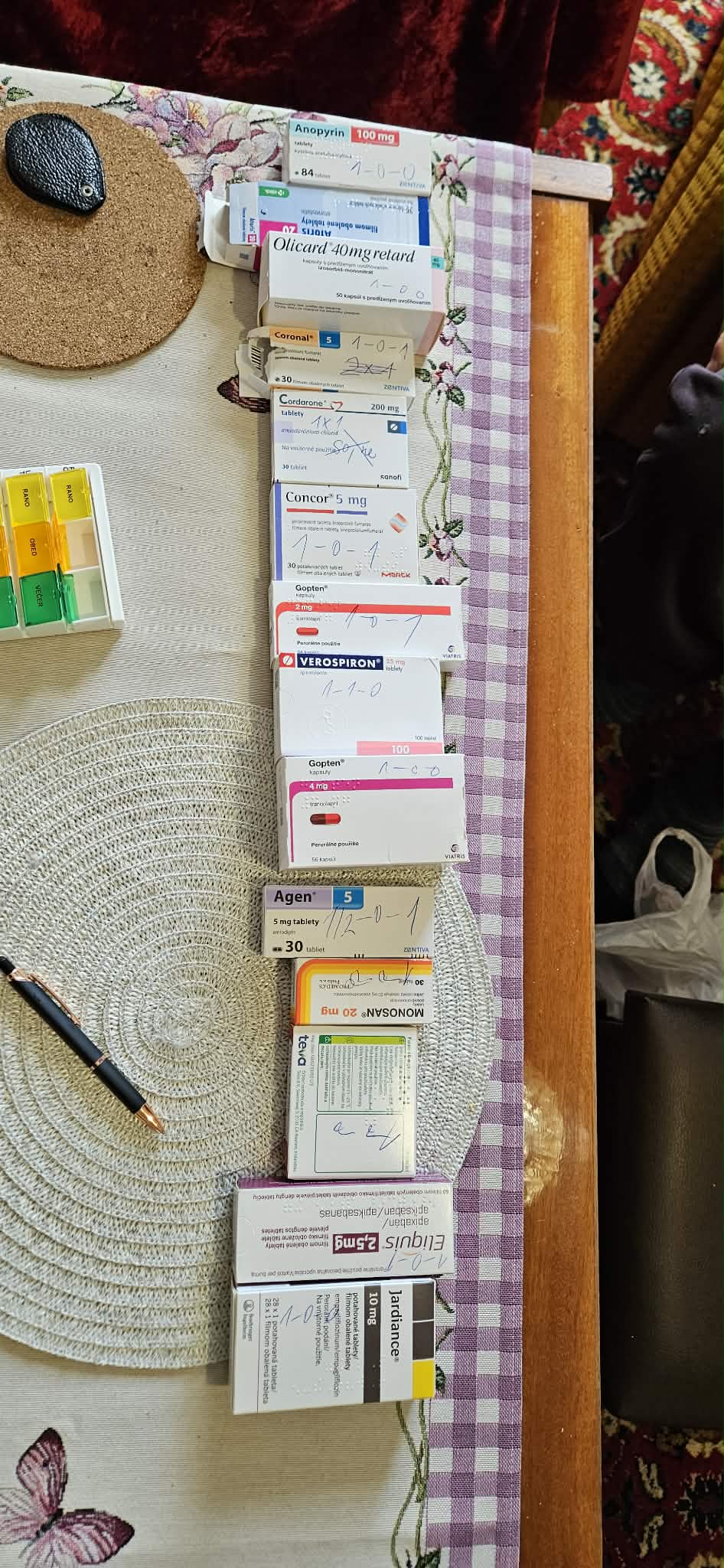
The photo my father sent me and from which the entire analysis developed.
I was asked to analyse the situation and put together a dosing schedule as quickly as possible: how should my grandfather take this collection of medicines as safely as possible, especially with regard to potential drug interactions? From my first look at the number of boxes, I knew it would not be simple.
Along with the photo, I entered the following prompt into ChatGPT and used Deep Research mode. At the time, processing took approximately 53 minutes. I am reproducing the original prompt below without edits:
Anopyrin 100 mg 1-0-0, Atoris 20 mg, Olicard 40mg 1-0-0, Coronal 5 1-0-1, Cordarone 200 mg 1 denne, Concor 5 mg 1-0-1, Gopten 2 mg 1-0-1 ,Agen 5 1/2-0-1, Monosan 20 mg 1-0-0, Eliquis 2,5 mg 1-0-1, Jardiance 10 mg 1-0-0, Furon Daj mi aj vhodnu schemu ako ma tieto lieky pacient brat. Je to 94 muz po krize srdcoveho zlyhavania , dnes prepusteny z hospitalizacie. Pacient nie je leziaci, vitalny. Som klinicky farmaceut.
You can view the output I received in the attached document, which is in Slovak:
Open the complete post-hospitalisation pharmacotherapy analysis (PDF, Slovak)
Output structure
The output was created by the GPT-5.4 model. Deep Research mode works differently from a regular ChatGPT conversation, which is why the processing took so long. As the prompt shows, I did not specify the expected structure or document formatting. I liked the result so much, however, that I incorporated its sections into the current tool and now instruct the model in the prompt to structure its output in a similar way.
-
The most important points at the very beginning of the document. The Executive summary immediately alerted me to potential problems: bisoprolol appeared twice in the photo (Coronal and Concor), nitrates were present in an unusual two-drug combination (Monosan and Olicard), and the same was true for antithrombotic medicines, or blood thinners (Eliquis and Anopyrin).
-
Sources and methodology. The second section summarises the sources and process underlying the clinical assessment in the later parts of the document.
-
Overview of the individual medicines. A table with basic information about each medicine follows. The length of this section depends on the number of medicines included in the analysis.
-
Interactions between medicines. These are presented in a structure similar to the overview of individual medicines.
-
Proposed daily medicine schedule.
What is different in the current tool, and why the first prompt matters
At first glance, it is clear that I described myself in the original prompt as a “clinical pharmacist”. That may help improve the results, but in my case it is not true. The language of the response is also too complex and often contains jargon that an ordinary community pharmacist may not understand. Explaining it may then require a longer follow-up conversation.
You can see the specific differences in the Pharmacotherapy analysis tool documentation, which describes every current part of the prompt.
There you will see how much more deliberately I now approach the opening prompt in RxOps compared with my first analysis. While using AI tools for programming, I noticed how much context accumulates in every conversation. That made me realise the enormous amount of information AI can effectively process. Working in a development team taught me that approximately 100,000 tokens is still a manageable amount before unusual deviations start appearing in responses. I do not know whether that estimate still holds, but even if it does not, it is already a large number.
Context also accumulates while an AI tool is working: responses, retrieved summaries of product characteristics (SmPCs), and other online sources are added along the way. Even so, I consider the user's input to be the most important. The user guides the conversation and lays its foundation with the first request. The opening prompt can be longer—even then, it may still represent only a small part of the amount of context AI can process.
The whole of RxOps, including my pharmacotherapy analysis tool, is built on this idea of a high-quality opening prompt.
Conclusion
I have already gone quite deep into the details. The output speaks for itself. Before the rise of AI, preparing an analysis like this would have taken a community pharmacist a very long time, and their normal workload would often have left no room for it. Today, that barrier is gradually falling, although generating a response still takes time—especially while waiting for the model to reason. That is why I still see this tool as something that needs a new kind of space and time in the pharmacy, where the analysis could be generated and then discussed.